- 1-800-667-6924
- info@vistasort.com
- 835 - 58th St E, Saskatoon, SK, S7K 6X5

High-precision air separation systems that remove dust, chaff, husk, and lightweight material from seed and grain streams — protecting downstream equipment and improving finished product quality. 24 models. Supplied and supported by Vistasort across Canada.
An aspirator is a critical piece of seed and grain processing equipment that uses a controlled air column to separate lightweight impurities from heavier, valuable product. Where screens separate by size and gravity separators separate by density, aspirators target aerodynamic properties — removing material that is too light or irregular to stay in the good product stream under controlled airflow.
The LMC Aspirator is a high-precision air separation system designed specifically for heavy-duty, continuous operation in commercial seed and grain processing environments. It is widely used as both a primary cleaning stage and as a pre-cleaning step ahead of gravity separators, color sorters, and air screen cleaners — protecting downstream equipment from dust loading and improving overall line efficiency.
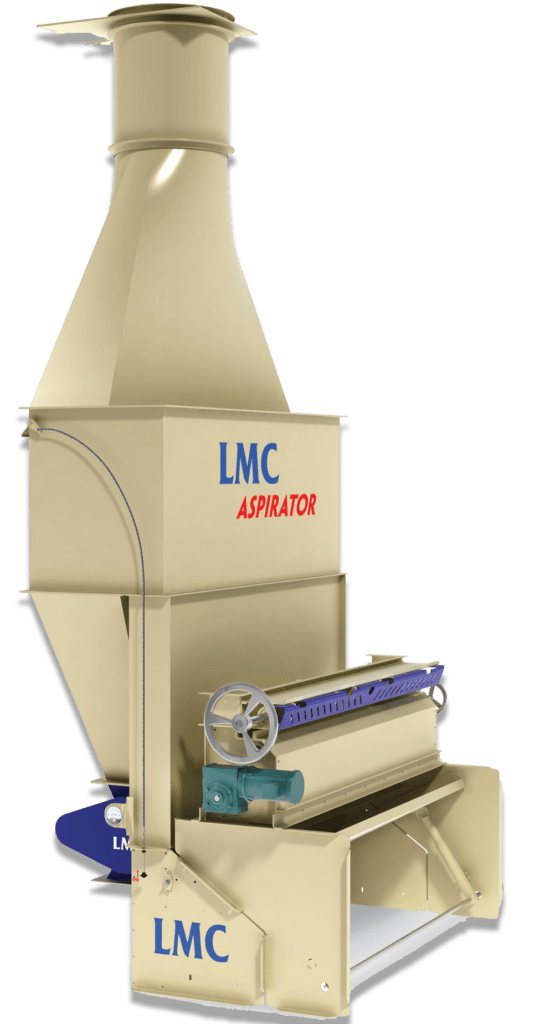
The aspirator uses a controlled air column to separate material based on density and aerodynamic profile — a simple, highly effective separation principle in continuous operation.
Product enters the aspirator via an adjustable in-feed system — either a vibratory in-feed pan or rack and pinion gate — which distributes product evenly across the full width of the air column for consistent separation performance.
Product falls through a precisely controlled vertical air column. Airflow velocity is set using adjustable control valves and monitored with a Magnehelic gauge (0–10" S.P.W.G.) to maintain exact separation conditions for each crop type.
The controlled airflow lifts lightweight material — dust, chaff, husk, and broken seed — upward and away from the product stream. Heavier, valuable product continues downward through the air column, unaffected by the airflow.
Cleaned product exits through the bottom discharge point and continues to the next stage of processing. The Vernier-controlled air bleed system provides fine-tuning capability to optimize the separation point without stopping production.
Removed lightweight material (liftings) is collected in outfall tanks and discharged separately via airlock or auger discharge systems — maintaining consistent air pressure within the separation column for stable, repeatable performance.
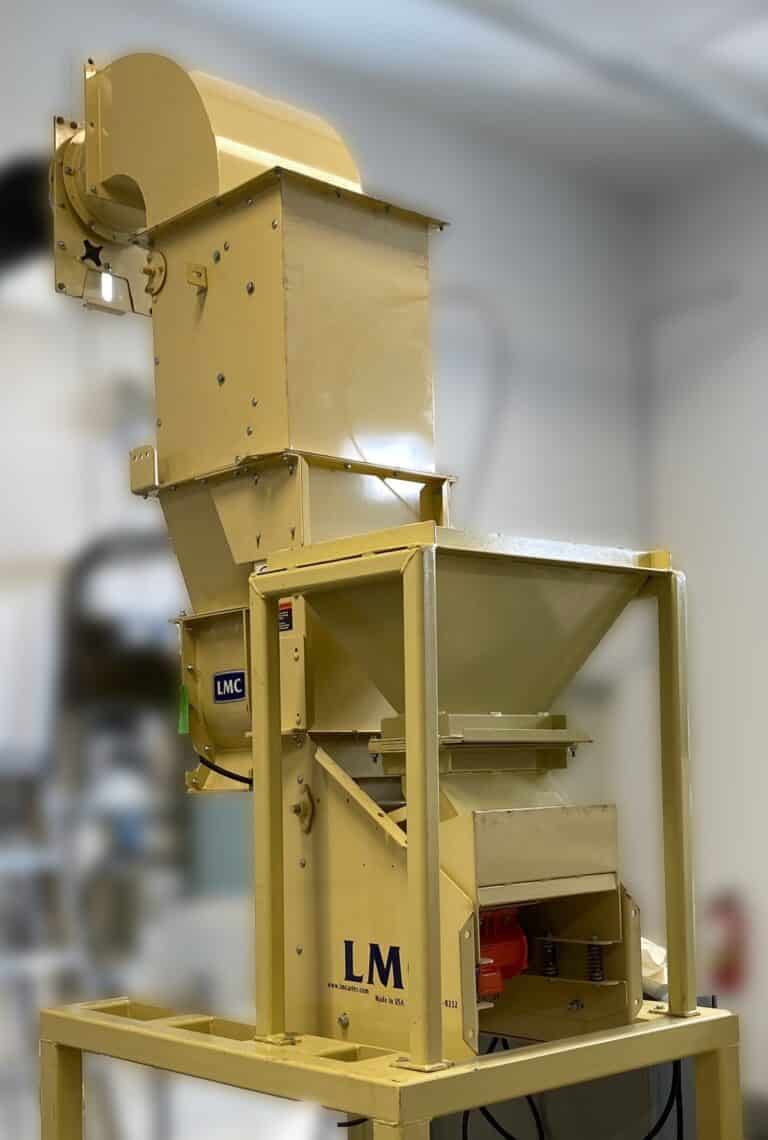
Watch the LMC Aspirator operating in a real seed and grain processing environment — supplied and supported by Vistasort across Canada.
LMC Aspirator air separation system — available through Vistasort, Western Canada's seed and grain processing equipment dealer.
Built for continuous, heavy-duty operation in commercial seed and grain processing environments with full operator control over separation accuracy.
The aspirator's vertical air separation column delivers consistent, uniform airflow across the full product stream — achieving repeatable separation of lightweight material regardless of throughput fluctuations.
Vernier-controlled air bleed valves allow operators to make precise micro-adjustments to airflow velocity without interrupting production — enabling fine-tuning of the separation point for different crop types and conditions.
Includes a Magnehelic gauge (0–10" S.P.W.G.) for continuous airflow monitoring — giving operators real-time visibility into separation conditions and enabling consistent, documented performance across shifts.
The vibratory in-feed pan provides uniform product distribution across the full air column width — ensuring even exposure of all product to the airflow for consistent separation without channeling or dead spots.
A precision rack and pinion in-feed gate provides repeatable, adjustable product feed rate control — allowing operators to balance infeed volume against air column capacity for optimal separation efficiency.
14 gauge bolted carbon steel body with 7 gauge carbon steel in-feed sides delivers long-term durability in demanding processing environments — reducing maintenance frequency and extending machine service life.
Outfall tanks collect removed liftings and discharge them via airlock or auger systems — maintaining consistent air pressure inside the separation column and enabling continuous operation without pressure fluctuations.
An aspirator/shaker combination configuration is available — combining air separation with mechanical scalping in a single unit for maximum pre-cleaning efficiency in a compact footprint.
Optional stainless steel product contact surfaces are available for food-grade applications where mild steel is not suitable — providing corrosion resistance and meeting food safety requirements for sensitive processing environments.
Understanding how aspirators fit into a complete processing line — and how they differ from gravity separators, air screen cleaners, and color sorters.
Uses controlled airflow to lift and remove lightweight material from the product stream based on aerodynamic properties.
Uses vibrating deck, airflow, and incline to stratify product by weight — separating same-size kernels that differ in density.
Uses screens of various apertures combined with airflow to remove oversized and undersized material from the product stream.
Most high-performance Canadian seed and grain processing lines use air screen cleaning → aspiration → gravity separation → optical color sorting in sequence. Each machine targets a different type of contaminant, together achieving export-grade purity that no single machine can deliver alone.
24 models available to match any throughput requirement — from small seed cleaning operations to large-scale commercial grain facilities.
LMC Aspirator models are designated by column width (in inches) and number of columns. A Model 366, for example, has a 36-inch column width with 6 columns. This modular system allows precise matching of aspirator capacity to your processing line's throughput requirements.
All airflow figures are stated in cubic feet per minute (CFM) at four standard face velocities — 2,500, 3,000, 3,500, and 4,000 feet per minute. The appropriate face velocity for your operation depends on the crop type, product density, and desired separation threshold.
| Model | CFM @ 2,500 fpm | CFM @ 3,000 fpm | CFM @ 3,500 fpm | CFM @ 4,000 fpm |
|---|---|---|---|---|
| 184 | 1,250 | 1,500 | 1,750 | 2,000 |
| 244 | 1,667 | 2,000 | 2,333 | 2,667 |
| 246 | 2,500 | 3,000 | 3,500 | 4,000 |
| 304 | 2,083 | 2,500 | 2,917 | 3,333 |
| 306 | 3,125 | 3,750 | 4,375 | 5,000 |
| 364 | 2,500 | 3,000 | 3,500 | 4,000 |
| 366 | 3,750 | 4,500 | 5,250 | 6,000 |
| 368 | 5,000 | 6,000 | 7,000 | 8,000 |
| 424 | 2,917 | 3,500 | 4,083 | 4,667 |
| 426 | 4,375 | 5,250 | 6,125 | 7,000 |
| 428 | 5,833 | 7,000 | 8,167 | 9,333 |
| 484 | 3,333 | 4,000 | 4,667 | 5,333 |
| 486 | 5,000 | 6,000 | 7,000 | 8,000 |
| 488 | 6,667 | 8,000 | 9,333 | 10,667 |
| 604 | 4,167 | 5,000 | 5,833 | 6,776 |
| 606 | 6,250 | 7,500 | 8,750 | 10,000 |
| 608 | 8,333 | 10,000 | 11,667 | 13,333 |
| 724 | 5,000 | 6,000 | 7,000 | 8,000 |
| 726 | 7,500 | 9,000 | 10,500 | 12,000 |
| 728 | 10,000 | 12,000 | 14,000 | 16,000 |
| 846 | 8,750 | 10,500 | 12,250 | 14,000 |
| 966 | 10,000 | 12,000 | 14,000 | 16,000 |
| 1086 | 11,250 | 13,500 | 15,750 | 18,000 |
| 1206 | 12,500 | 15,000 | 17,500 | 20,000 |
* All airflow figures in CFM (Cubic Feet per Minute). fpm = feet per minute face velocity. Contact Vistasort for model selection guidance specific to your crop type, throughput, and processing line configuration.
The LMC Aspirator is widely used across multiple grain and seed industries — delivering measurable purity improvements in every crop category.
Aspirators remove dust, broken kernels, and lightweight impurities before milling or export — improving grade, reducing dockage, and protecting downstream processing equipment from dust loading.
In peas, lentils, chickpeas, and navy beans, aspirators remove dust and split material — improving visual quality and downstream color sorter performance by clearing the optical path of fine particles.
Oilseeds and forage crops benefit from controlled airflow separation to remove husks, chaff, and lightweight contaminants — protecting oil quality and extraction yield in downstream processing.
Lightweight grass and forage seeds require precise, low-velocity airflow control. LMC's adjustable Vernier controls allow fine-tuning for the delicate aerodynamic separation required for small-seeded crops.
High-value specialty crops with strict purity tolerances rely on aspiration to remove dust and chaff before color sorting — ensuring the sorter's optical systems are not compromised by particulate contamination.
LMC Aspirators are also used in industrial processing to separate lightweight contaminants from recyclable materials and specialty products — wherever aerodynamic separation of dry, flowable materials is required.
Vistasort is your Western Canadian LMC dealer with over 40 years of seed and grain processing experience — providing more than just equipment supply.
LMC (Lewis M. Carter Manufacturing) is a leading manufacturer of seed and grain processing equipment. Vistasort is the authorized Western Canadian LMC dealer — supplying, integrating, and supporting LMC aspirators, gravity separators, and related equipment across Canada.
Vistasort has been designing and equipping seed and grain processing facilities across Western Canada since 1986. We understand Prairie crops, processing conditions, and export-grade quality requirements — and we apply that experience to every aspirator installation.
Because Vistasort supplies the complete equipment portfolio — aspirators, gravity separators, color sorters, screens, and conveyance — we can design your aspirator installation as part of a fully integrated processing line, not just a standalone equipment sale.
Vistasort is based in Saskatoon, Saskatchewan — providing Canadian-based service, parts availability, and technical support for every LMC aspirator we supply. You're not dealing with an overseas manufacturer; you have a local partner who can respond quickly when you need support.
Every processing operation is different. Vistasort provides custom system engineering for cereals, pulses, oilseeds, and specialty crops — selecting the right aspirator model, configuring the infeed and discharge systems, and integrating the unit into your specific line layout.
Answers to the most common questions about aspirators and how they fit into seed and grain processing operations across Western Canada.
Tell us your crop, throughput, and processing goals — Vistasort will recommend the right aspirator model and integration approach for your facility.
Aspirators work best as part of a complete processing line. Explore the other equipment Vistasort supplies and supports across Canada.