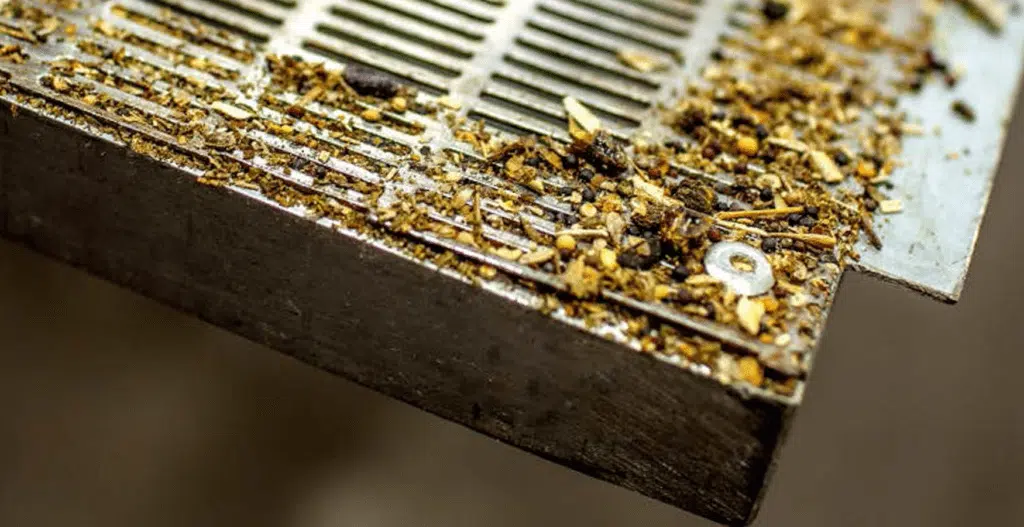
The right seed cleaning screen determines what stays in your product and what gets removed. Vistasort supplies replacement grain cleaning screens, Border Series, wire mesh, and perforated plate, for Clipper, Carter Day, and most air screen cleaner brands. Stocked in Saskatoon.
Seed cleaning screens are the perforated or wire mesh panels inside your air screen cleaner, the physical media that determine what passes through to clean product and what gets rejected as screenings. A top scalping screen removes oversized material: straw, pods, caked soil, and large weed seeds. A bottom underscreen removes undersized material: broken kernels, small weed seeds, and fine debris.
Everything the air screen cleaner achieves depends on correct screen selection. If the opening is wrong for your crop, you lose yield, miss grade, or pass contamination that belongs in the tail. With over 40 years of screen sizing experience, Vistasort helps Canadian processors choose the right screen for the right crop the first time, not after two bad production runs.
Vistasort stocks replacement seed cleaning screens for Clipper and Carter Day air screen cleaners, the same brands Vistasort has supplied and supported since 1986. Whether you need Clipper cleaner screens or replacement grain cleaning screens for a Carter Day, contact us with your machine model and frame dimensions and we will match a screen to fit.
Not all replacement seed cleaning screens are built the same. Vistasort's Border Series addresses the most common failure point in screen performance, and every screen we supply is built for product purity, maximum screen area, and long service life.
Standard replacement screens leave a gap between the screen panel and the cleaner's internal frame rail. Product bypasses the screen through this gap, passing from inlet to discharge without being separated. In food-grade and certified seed operations, this edge bypass is a contamination risk and a compliance issue. In any operation, it is a grade and yield problem.
Border Series screens are manufactured with a solid border that covers the frame rail completely. There is no gap, no bypass path, and no opportunity for unsorted product to skip the screen. This design simultaneously maximizes the active screening area, more of the screen does separation work, improving both efficiency and throughput at the same mesh or perforation size.
For operations that must demonstrate clean-product integrity, certified seed producers, export packers, food-grade pulse processors, Border Series is the correct choice. Contact Vistasort to confirm Border Series availability for your cleaner model.
Screen openings come in round holes, oblong slots, and triangular perforations, each shape suited to different separation tasks. Round holes are the standard for most seed cleaning applications. Oblong slots allow undersized material to pass while retaining elongated seeds. Triangular perforations are used in specialty separations where shape-based retention is required. Vistasort selects perforation type based on your crop's dimensional profile and the contaminant you are removing.
The frame holds the screen media under tension and must fit the cleaner's internal deck dimensions precisely, a loose frame allows product bypass and vibration fatigue. Vistasort supplies frames in wood (traditional, low-cost, suitable for standard environments), steel (high-durability for commercial continuous-duty operation), and aluminum (lightweight and corrosion-resistant for food-grade and high-moisture environments). Frame selection is matched to your machine model and operating conditions.
Wire mesh screens use woven steel wire to create precise openings, lighter, flexible, and well-suited for fine separations in seed cleaning where opening uniformity is critical. Perforated plate screens are punched from steel sheet and provide greater rigidity and durability, preferred in commercial operations handling abrasive crops or high-tonnage throughput. Both types are available across the full range of opening sizes required for Western Canadian crop production.
Traditional and widely available. Low replacement cost. Well-suited for Clipper air screen cleaners and standard seed cleaning environments. Not recommended for high-moisture or food-grade environments where dimensional swelling may affect fit.
Maximum durability for commercial continuous-duty operation. Maintains dimensional stability under heavy-throughput conditions and longer service life than wood in high-volume facilities. Standard in Carter Day and heavy commercial air screen cleaners.
Lightweight and corrosion-resistant. Preferred for food-grade certified operations, certified seed facilities, and high-moisture processing environments where steel rust is a food-safety risk. Comparable service life to steel with lower weight-per-deck.
Different crops require different grain cleaning screen configurations. The table below outlines the key separation objective, primary challenges, and Vistasort's general screen guidance for each crop type. Contact us for exact opening specifications, crop dimensions vary by variety and harvest year.
| Crop | Primary Separation Objective | Key Challenges | Screen Notes | Downstream Pairing |
|---|---|---|---|---|
 Red Lentils Red Lentils | Export grade sizing, multiple fractions | Stone contamination; broken/cracked lentils | Round hole underscreen; sizing shaker for export grade fractions | Destoner Color Sorter |
 Green Lentils Green Lentils | Foreign material removal; grade sizing | Stones; damaged seed from harvest | Similar to red lentils, round holes; opening matched to variety size | Destoner Gravity Sep. |
 Yellow Peas Yellow Peas | Scalp straw and pods; remove fine debris | High stone risk; large seed requires wider spacing | Larger round openings; robust top scalping screen for heavy harvest trash | Destoner Bean Polisher |
 Navy Beans Navy Beans | Foreign material; broken bean removal | Splits and cracks are common; visual grade matters | Round holes; tight underscreen to catch broken halves | Gravity Sep. Color Sorter |
 Beans (dry) Beans (dry) | Scalping; FM removal | Variable seed size by variety; pod fragments | Confirm opening to variety dimension; pod-fragment scalping is critical | Destoner Color Sorter |
 Wheat Wheat | Weed seed removal; scalp straw and pods | Wild oat; ergot; frost-damaged kernels | Standard round-hole wire mesh; ergot removal requires gravity table + color sorter | Gravity Sep. Indent Sep. |
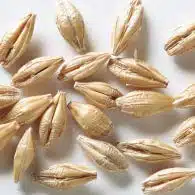 Barley Barley | Primary cleaning + plumpness sizing for malt grade | Malt grade requires kernel plumpness spec | Sizing shaker often required downstream for plumpness grade fractions | Sizing Shaker Gravity Sep. |
 Oats Oats | Scalp large chaff; remove thin oats | Long kernel; requires slot-style opening for shape retention | Oblong slot underscreen to retain full oats; wide top scalping screen | Impact Huller Gravity Sep. |
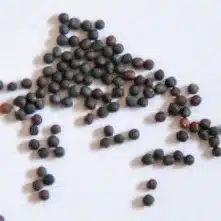 Canola Canola | Remove fine weed seeds; scalp pods and stems | Very small round seed; fine wire mesh required | Fine wire mesh underscreen, small opening critical to avoid canola loss through bottom | Gravity Sep. Color Sorter |
 Mustard Mustard | Remove foreign material from small round seed | Similar in size to weed seeds; precise separation needed | Fine wire mesh; similar profile to canola, contact Vistasort for opening spec | Gravity Sep. Color Sorter |
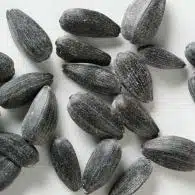 Sunflower Sunflower | Scalp large debris; remove small foreign material | Elongated kernel shape; requires oblong or slot-style opening | Oblong slot screens; wide top scalping screen for large achene | Impact Huller Gravity Sep. |
 Peanuts Peanuts | Size grading; shell fragment removal | Large seed; shell fragments common; food-grade requirements | Large round or oblong openings; aluminum frames recommended for food-grade lines | Destoner Color Sorter |
 Canary Seed Canary Seed | FM removal; small seed retention | Very small seed; fine weed seeds present in similar size range | Fine wire mesh; tight underscreen critical, canary seed is high-value crop | Gravity Sep. Color Sorter |
 Grass Seed Grass Seed | Weed seed separation; variety purity | Extremely fine seed; tight tolerances for certified seed lots | Very fine wire mesh; disc machine and spiral separator often required for full separation | Disc Machine Spiral Sep. |
✱ This table provides general directional guidance only. Screen opening sizes vary by variety, harvest year, and Canadian Grain Commission grade specifications. Contact Vistasort for crop-specific screen sizing recommendations before ordering.
Air screen cleaners are the first major separation step in every cleaning line. The seed cleaning screens inside them determine how much work the downstream machines need to do. Getting your screens right reduces load on gravity separators, color sorters, and destoners.
Field-run product carries dust, chaff, stones, and varying amounts of foreign material. An aspirator removes light material before the air screen cleaner to reduce load and improve screen efficiency. A magnetic separator protects downstream equipment from ferrous metal.
Your cleaning screens do their work here, scalping oversized material on top, removing undersized material below, and using aspiration to lift off lightweight debris simultaneously. This is the primary separation step, handling the majority of the cleaning load.
After air screen cleaning, secondary machines handle what screens and air cannot separate: density (gravity separator), length (indent separator), shape (disc machine, spiral), and heavy foreign material (destoner). Correct screen work at step 2 reduces contamination pressure on these machines.
The VistaSort color sorter is the final quality checkpoint, removing discoloured, damaged, or foreign-coloured material that passed through every previous stage. Clean screen work upstream means the color sorter handles less volume and delivers higher purity at the output.
Screen requirements vary significantly by crop group. Here is how Vistasort generally approaches screen selection for the four major Western Canadian crop categories.
Cereal cleaning lines focus on removing weed seeds, scalping straw and pods, and sizing for grade. Malt barley requires kernel plumpness sizing, a sizing shaker is often needed downstream.
Pulse cleaning lines require robust top scalping screens to handle heavy harvest trash, and careful underscreen sizing to retain crop while removing fine debris and small weed seeds. Stone contamination is common, destoning follows screening.
Oilseed lines require fine wire mesh for small round seeds like canola and flaxseed, and oblong or slot-style screens for elongated sunflower achene. Precise opening selection is critical, opening too large loses valuable product.
Specialty seed and grass seed cleaning requires the finest wire mesh screens available, seed lots are often high-value certified seed where variety purity standards are strict. Additional equipment is almost always required to achieve required purity.
Vistasort stocks and ships replacement seed cleaning screens from Saskatoon, Saskatchewan, to processors nationwide, with the strongest presence across Western Canada.
Vistasort supplies replacement seed cleaning screens to seed and grain processors across Canada, matched to your air screen cleaner model, crop, and frame material. Screens are stocked in Saskatoon and shipped nationwide, with no overseas lead time.
Our strongest regional presence. Vistasort supplies seed cleaning screens across Western Canada, including British Columbia, Alberta, Saskatchewan, and Manitoba, supported directly from our Saskatoon home base rather than an out-of-country distributor.
Buying a replacement screen is simple. Buying the right replacement screen is something else. Screen selection requires knowing how the target crop's dimensional profile intersects with the contaminants you are trying to remove, and that knowledge comes from running lines on real crops in real conditions for four decades.
Steven Chivilo and Chris Hammel have been configuring air screen cleaners and selecting screens for Canadian seed cleaning operations since 1986. When you call Vistasort for a screen recommendation, you are talking to someone who has seen the same separation problem you have, across wheat, lentils, canola, peas, grass seed, and specialty crops, and knows which screen opening works and which one doesn't.
Screens are stocked in Saskatoon. You are not waiting for an international shipment. Contact us with your machine model and crop and we will tell you what we have in stock and what we recommend.
Tell us your machine model and the crop you are cleaning, we will recommend the correct screen, confirm what is in stock, and get it to you without an international lead time. No obligation.
Call +1-306-242-9292 | Toll-free +1-800-667-6924 | info@vistasort.com