What Is Ergot and Why It Matters in Canadian Grain Processing
Ergot in Western Canadian Crops
Ergot is a toxic fungal growth that infects cereal crops such as wheat, barley, rye, and triticale. In Canada, ergot contamination is a major concern due to strict grading standards, export requirements, and food safety regulations.
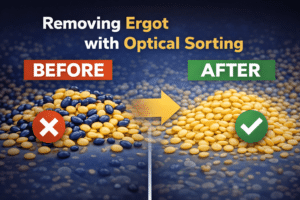
Ergot bodies differ in color, density, and shape from healthy kernels, making them detectable through optical sorting systems. However, traditional seed cleaning equipment alone cannot consistently remove ergot at commercial purity levels.
For Canadian seed and grain processors, removing ergot improves product quality, reduces dockage, and increases market value.
Why Ergot Matters to Producers:
Strict Canadian Grain Commission export limits
Reduced grade and dockage penalties
Food and feed safety concerns
Rejection of shipments by international buyers
Ergot bodies are typically dark purple or black, making them visually distinct, but difficult to remove with traditional mechanical cleaning alone.
How VistaSort Color Sorters Remove Ergot
Advanced Imaging and Detection
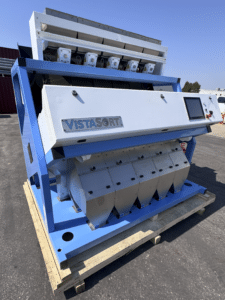
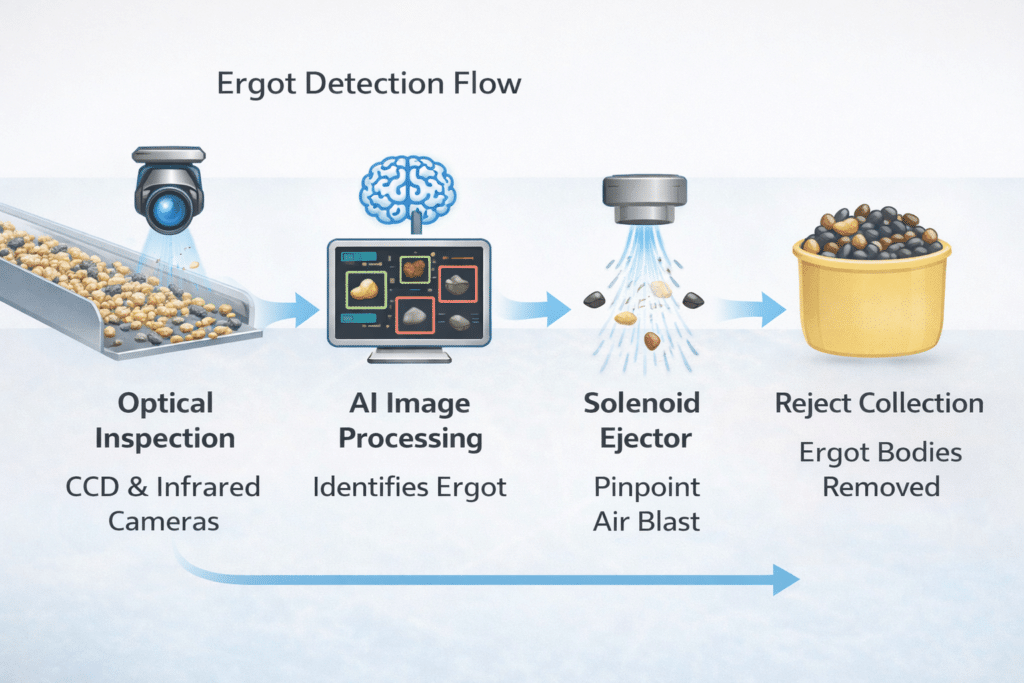
VistaSort color sorters use high-resolution CCD cameras and optional infrared sensors to scan every kernel as it passes through the inspection zone. Ergot kernels differ in color, texture, and shape, making them ideal targets for optical detection.
Key detection characteristics:
Dark purple or black coloration
Irregular elongated shape
Surface texture differences
Internal density differences (with multispectral systems)
Intelligent Image Processing Algorithms
The system analyzes multiple parameters in real time:
- Color
- Shape
- Size
- Texture
This multi-parameter detection ensures ergot kernels are removed even when color differences are subtle.
High-Speed Ejector Systems
Once ergot is detected, high-speed electromagnetic ejectors fire a precise pulse of air to remove the contaminated kernel while allowing clean grain to continue.
This process happens thousands of times per second, enabling high-throughput sorting without sacrificing accuracy.
Italian electromagnetic solenoid ejectors deliver millisecond response times, ensuring:
- Pinpoint defect removal
- Minimal good grain loss
- Consistent throughput at scale
User Interface and Operator Control
VistaSort color sorters feature an intuitive touchscreen user interface designed for seed cleaning operators and grain processing technicians. The interface allows users to fine-tune ergot detection thresholds based on crop type, contamination levels, and grading requirements.
Operators can adjust color sensitivity, size filtering, and rejection parameters in real time, ensuring optimal ergot removal without excessive good grain loss. Preset profiles for wheat, barley, rye, and specialty crops help Western Canadian facilities maintain consistent quality across multiple product lines.
Real-time monitoring tools provide visual feedback on rejection rates, throughput, and system performance, helping operators verify ergot removal efficiency and maintain export-grade purity standards.
Dust Control and Structural Design
Ergot contamination often occurs in dusty grain handling environments, which can interfere with optical detection. VistaSort systems are engineered with integrated dust extraction and sealed optical inspection chambers to maintain a clean detection environment.
Advanced dust control ensures cameras and sensors maintain consistent accuracy, even in high-throughput Western Canadian grain facilities. The structural frame is built for industrial durability, with reinforced steel construction designed for continuous operation in seed cleaning plants and commercial grain elevators.
By maintaining a controlled inspection environment, VistaSort systems reduce false rejects and ensure reliable ergot detection over long operating cycles.
Sampling and Collection Systems
Effective ergot removal requires precise separation and collection of rejected material. VistaSort color sorters use dedicated reject chutes and collection systems to separate ergot bodies and foreign material from clean grain streams.
Sampling ports allow operators to inspect rejected material and verify system accuracy. This is particularly important for Canadian seed processors and exporters who must document grading compliance and product purity.
Integrated collection systems ensure rejected ergot kernels are contained and easily removed from the processing line, reducing contamination risk and improving facility cleanliness.
Data Logging and Quality Verification
VistaSort systems can log sorting data and rejection metrics, helping processors document quality improvements and compliance with Canadian grading standards. This data-driven approach supports export documentation and internal quality assurance programs.
Applications in Western Canadian Grain Processing
Western Canada’s export-driven grain industry faces strict grading and food safety standards, making ergot removal a critical step in modern processing. Optical color sorting is widely used across Saskatchewan, Alberta, and Manitoba to help processors meet CFIA grading limits and international buyer specifications.
In Prairie grain facilities, optical sorting is typically used as a final polishing step after air screen cleaning and gravity separation to ensure consistent purity and export-ready quality.
Wheat and Barley
Optical color sorting is widely used in wheat and barley processing to remove ergot bodies, discolored kernels, and foreign material before milling or export.
In Saskatchewan and Alberta, where large-volume export terminals demand tight visual quality standards, optical sorting helps processors reduce dockage, avoid grade downgrades, and improve shipment acceptance rates.
Key benefit: Higher grade grain, fewer penalties, and improved export pricing.
Rye and Triticale
Rye and triticale are particularly susceptible to ergot contamination in Western Canada due to flowering characteristics and Prairie growing conditions.
In Manitoba and Saskatchewan rye processing facilities, optical sorting is often required to meet food-grade and milling tolerances, where even small ergot levels can lead to rejected loads. Optical color sorting provides a reliable final step to ensure compliance without sacrificing throughput.
Key benefit: Reliable compliance with strict domestic and international food safety standards.
Specialty Crops and Export Markets
Optical color sorting is also widely used in Western Canadian specialty crop facilities, including:
Canary seed (Saskatchewan specialty markets)
Oats
Pulses (lentils, peas, edible beans)
Specialty cereals and niche grains
These crops often serve premium export markets in Europe, Asia, and the Middle East, where visual purity and consistency directly impact contract pricing. Optical sorting removes ergot, discolored kernels, splits, and foreign material that traditional cleaning equipment may miss.
Key benefit: Premium-grade product that meets global buyer specifications and contract requirements.
Why This Matters for Canadian Processors
For Western Canadian processors, optical color sorting is not just a quality upgrade, it is a risk management tool. Removing ergot reduces export rejections, protects brand reputation, and increases the value of every tonne processed.
Prairie Processing Insight: Why Ergot Removal Matters in Canada
Ergot contamination is managed in Canada through grain grading standards and market quality requirements. The Canadian Grain Commission (CGC) recognizes ergot bodies as a grading factor in wheat, barley, rye, oats, and other cereal grains, and shipments exceeding tolerance levels may be downgraded or rejected by buyers.
Optical color sorting helps Western Canadian processors consistently meet grade specifications, protect market access, and maintain product value.
According to the Canadian Grain Commission Official Grain Grading Guide, typical tolerances for food-grade cereals generally fall in the range of approximately 0.01% to 0.04%, depending on crop type, grade class, and end-use market requirements. Export buyers and processors often enforce stricter thresholds, making optical color sorting a critical step in modern grain processing facilities across Saskatchewan, Alberta, and Manitoba.
CFIA Ergot Tolerance Limits in Canadian Grain
Crop Type | Typical Maximum Ergot Tolerance (Food Grade) | Notes for Western Canadian Processors |
|---|---|---|
Wheat | ~0.04% | Affects milling grade and export acceptance; stricter buyer contract limits are common |
Barley | ~0.04% | Critical for malting and export markets; higher tolerance allowed for feed barley |
Rye | 0.01–0.04% | Highly susceptible to ergot; buyers often impose very low tolerance thresholds |
Triticale | 0.01–0.04% | Similar risk profile to rye; often downgraded quickly without optical sorting |
Oats & Specialty Cereals | Contract-based (often near zero) | Buyer specifications frequently stricter than CGC grading standards |
Tolerance limits vary by grade, crop class, and buyer contract. Producers and processors should consult current Canadian Grain Commission and CFIA documentation for official requirements.
To learn more and read the official Canadian Grain Commission grading standards, visit:
Ready to Improve Seed and Grain Sorting Accuracy?
VistaSort color sorters are trusted by seed processors, grain cleaners, and specialty crop operations across Canada and internationally. Whether upgrading an existing processing line or designing a new facility, VistaSort delivers precision sorting, scalable capacity, and long-term reliability.
With more than 150 installations across Canada and globally, Vistasort Technologies provides and supports a complete portfolio, including seed cleaning, optical color sorting, seed treating, packaging, and complete plant design and build.
Contact us today to schedule a demo, request specs, or speak with one of our product specialists. We are proud to support the seed and grain processing industry in Canada.